Our top-tier consultancy services provide strategic guidance to elevate your entire digital presence.
Learn More


 " />
" />
 " />
" />
 Max
|
June 26, 2026
|
AI & Automation, Digital Marketing
Max
|
June 26, 2026
|
AI & Automation, Digital Marketing
Contents
If your team still spends hours every week manually typing IC numbers into spreadsheets, re-entering receipt totals for claims, or chasing down medical certificates buried in someone’s inbox — you’re not alone, and you’re not stuck with it either.
AI OCR software is quietly becoming one of the most practical entry points into digital transformation for Malaysian businesses. Unlike the clunky scanning tools of a decade ago, modern AI-powered OCR (Optical Character Recognition) doesn’t just “read” a document — it understands what it’s looking at, extracts the right fields automatically, and feeds that data straight into your business systems.
Here’s what it actually does, where it saves the most time, and what to look for if you’re evaluating AI OCR software for your organisation.
Traditional OCR converts an image of text into machine-readable text — useful, but limited. It struggles with handwriting, inconsistent layouts, and documents that don’t match a fixed template.
AI OCR adds a layer of machine learning on top of that text extraction. Instead of just reading characters, it recognizes context — it knows that a 12-digit number in a specific position on a Malaysian IC is the identification number, not a random figure, and it can pull that field out automatically even if the document is slightly rotated, low-resolution, or inconsistently formatted.
In practical terms, this means AI OCR can reliably handle:
Document automation isn’t a side trend — it’s part of a much larger shift already underway. Malaysian SMEs make up the overwhelming majority of business establishments in the country and are a major contributor to GDP and employment nationally, which means even small efficiency gains at the SME level translate into a meaningful national impact. Malaysian SMEs make up 97.2% of total business establishments, contributing 38.2% of GDP and employing 7.3 million people.
At the same time, government-backed digital incentives are accelerating adoption across the board, with smaller firms specifically targeted to close the technology gap with larger enterprises. SMEs are projected to be the fastest-growing segment of Malaysia’s digital transformation market through 2031, helped by grants that can fund a large share of digital spending.
For most organisations, document-heavy processes — HR verification, claims, invoicing, compliance paperwork — are the easiest and fastest place to start, because the manual cost is so visible and the automation is so measurable.
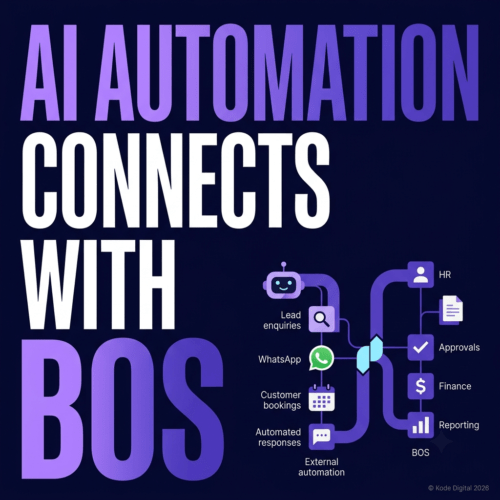
We built this exact approach into Kunos, Kode Digital’s AI-powered organisation management system. By mapping these four use cases directly to dedicated modules — HR, Leave, Operations, and Document Centre — AI OCR is natively integrated into every workflow rather than added as an afterthought.
It’s easy to underestimate how much manual document handling actually costs, because the time is spread across many small tasks rather than one obvious line item. A rough way to see it: if 3–4 staff members each spend even 30–45 minutes a day on document-related data entry — verifying ICs, re-typing receipt totals, processing medical certs — that’s collectively 20+ hours a week, every week, spent on work a properly configured AI OCR system can do in seconds per document.
The hidden cost isn’t just time — it’s the error rate. Manual re-typing introduces mismatches that surface later as approval delays, payment disputes, or compliance gaps during an audit.
If you’re evaluating AI OCR software for your organisation, a few things matter more than the marketing copy will tell you:
Is AI OCR accurate enough for Malaysian IC and passport documents? Yes, when the AI OCR model has been trained specifically on local document formats. Generic global OCR tools are less reliable here, which is why locally-built solutions tend to perform better on Malaysian-specific documents.
Can AI OCR handle handwritten medical certificates? Modern AI OCR can extract mixed printed and handwritten fields with reasonable accuracy, though clarity of handwriting still affects results. Most platforms allow for manual review/correction on lower-confidence extractions rather than blind automation.
Is on-premise AI OCR necessary, or is cloud-based fine? It depends on your sector. Government agencies and healthcare organisations often have data residency requirements that make on-premise or locally-hosted deployment the safer, sometimes mandatory, choice. For general SMEs, cloud-based AI OCR is usually sufficient.
How long does it take to implement AI OCR in an existing business system? This varies by vendor and how deeply OCR needs to integrate with existing workflows, but module-based platforms (where OCR is built into HR, Finance, or Document modules rather than a standalone bolt-on) are typically faster to roll out than custom integrations.
AI OCR is one of the fastest ways to see a measurable return from digital transformation — the time savings are immediate and easy to track, and the technology has matured enough to handle Malaysian-specific documents reliably.
If you’re exploring AI OCR as part of a broader move toward a centralised organisation management system, it’s worth looking at platforms where OCR isn’t a separate tool bolted onto your existing systems, but a feature built directly into HR, Finance, Operations, and Document Management — which is precisely how we designed Kunos to operate. You can also explore our SEO services package or performance ad package to further scale your business reach.
353-3 Jalan C. Y. Choy,
10300 George Town,
Penang, Malaysia.
A-16-8 Tropicana Avenue,
No 12 Persiaran
Tropicana, PJU 3, 47410
Petaling Jaya, Selangor.



















 Singapore
 Australia