Our top-tier consultancy services provide strategic guidance to elevate your entire digital presence.
Learn More


 " />
" />
 " />
" />
 zayar
|
July 9, 2026
|
AI & Automation
zayar
|
July 9, 2026
|
AI & Automation
Contents
Most Malaysian organisations don’t have one automation problem — they have two. Their internal operations (HR, finance, documents, approvals) run on manual, disconnected systems. And their customer-facing operations (leads, enquiries, bookings) rely on people to respond fast enough to win the business. Solve only one side, and the other keeps bleeding hours and revenue.
That’s exactly the gap that opens up when you connect AI automation with BOS, Kode Digital’s AI-powered organisation management system. One handles what happens inside your organisation. The other handles what happens outside it, with your customers. Together, they form a single, connected AI-powered business operating system — not two separate tools bolted together.
This article breaks down what each system does, exactly how they connect, and why Malaysian businesses are increasingly running both under one roof.
BOS (Business Operating System) is Kode Digital’s all-in-one organisation management system, built to replace the fragmented HR, finance, operations, and document-management tools that most Malaysian organisations are still stitching together manually.
Instead of HR software here, a separate finance tool there, and shared drives full of unstructured documents, BOS brings everything into one secure, PDPA-compliant, locally-hosted platform:
In short, BOS is the enterprise workflow management system that runs your organisation’s internal engine — HR, operations, finance, and compliance, all in one secure workspace.
Where BOS manages your internal operations, AI automation is what puts your sales, support, and customer engagement on autopilot.
Kode Digital’s AI automation service connects intelligent AI agents to the tools a business already uses — CRM, calendar, website, and WhatsApp — so that:
It’s built around a clear process: discovery and process mapping, use-case scoping, solution design, build and training, integration, testing, launch, and ongoing optimisation. The output is a custom AI agent or chatbot that behaves like a trained team member — one that never sleeps, never forgets a lead, and never mishandles a handoff.
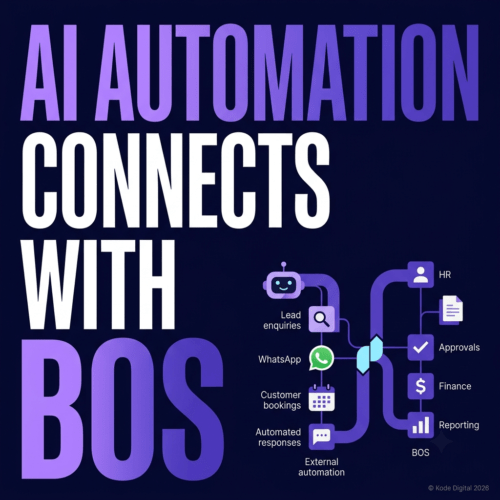
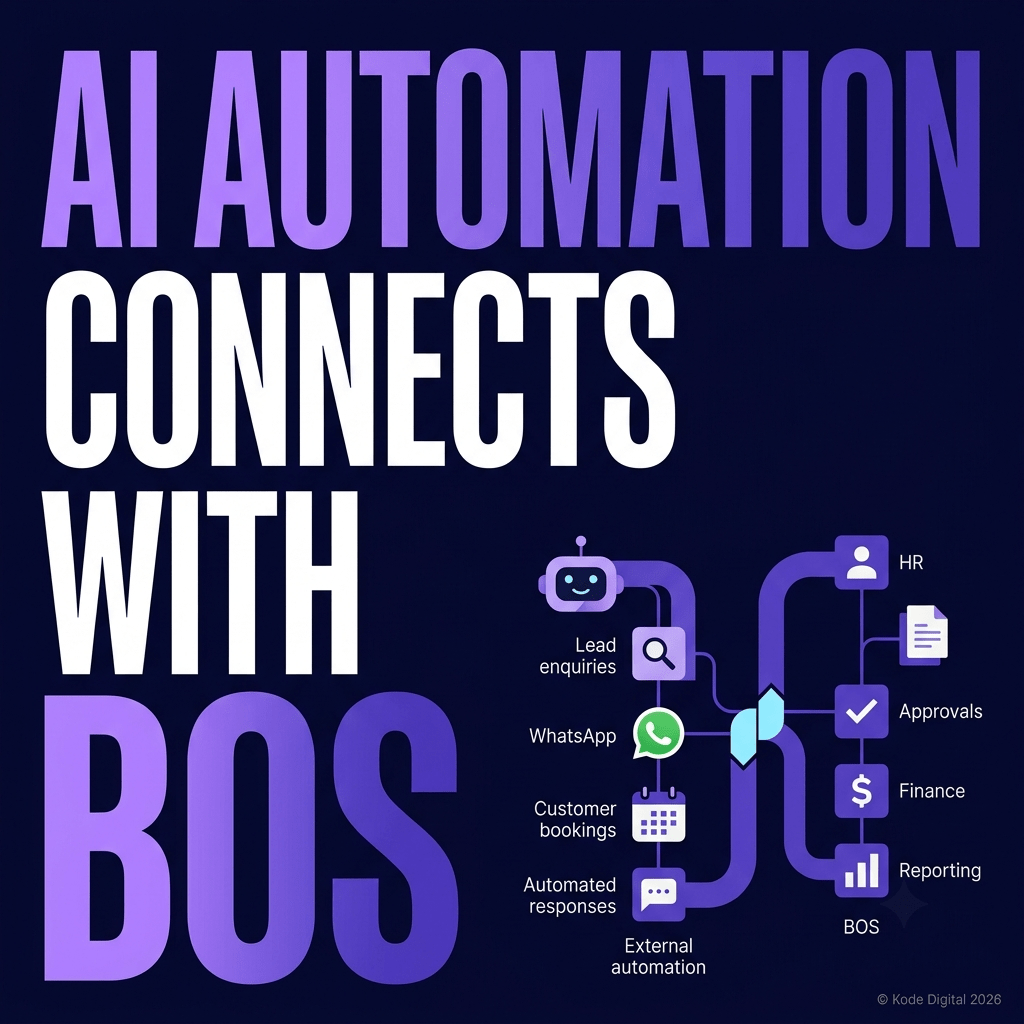
Here’s where it gets interesting. BOS and AI automation aren’t competing systems — they’re designed to plug into the same operational backbone. Here’s how the connection actually works in practice.
BOS already includes native AI OCR software inside its SmartPacks — reading IC/passport documents, receipts, invoices, and medical certificates automatically instead of requiring manual data entry. Layer AI automation on top, and that extracted data can trigger the next action on its own: routing an invoice for approval, flagging a policy violation, or notifying the right department — with zero manual handoff between systems.
Kode Digital’s AI automation service builds AI chatbots and WhatsApp automation that qualify leads and answer customer questions instantly. When that automation is connected to BOS, a customer enquiry, staff request, or facility booking captured by an AI agent can flow straight into BOS’s ticketing, helpdesk, or Room/Facility Booking modules — no one re-typing the same request twice.
BOS’s Forms & Approvals — Workflow Automation module already replaces manual paperwork with digital workflows. Add a custom AI agent, and approvals can be pre-screened, summarised, or auto-routed based on policy logic — for example, automatically flagging a leave request that breaches company policy before it even reaches a manager’s queue (a capability BOS’s Leave SmartPack already applies through AI Policy Violation Detection).
AI automation captures, scores, and nurtures leads the moment they arrive. Once connected to BOS’s real-time reporting and analytics dashboard, leadership doesn’t just see HR and operational KPIs — they see customer pipeline data in the same centralised view, instead of digging through a separate CRM export.
Because BOS is built as an on-premise, PDPA-compliant business system with role-based access and full audit trails, connecting AI automation to it doesn’t mean exposing sensitive data to fragmented third-party tools. Integrations are designed to respect the same governance and data-residency standards BOS was built around — which matters for government agencies, healthcare networks, and any organisation that can’t put sensitive data on shared cloud infrastructure.
Most Malaysian organisations undergoing digital transformation hit the same four walls:
An organisation management system like BOS solves the internal half of that problem. AI automation solves the external, customer-facing half. Running them separately still leaves a gap where data has to be manually moved between the two. Running them connected closes that gap — giving you one continuous flow from the moment a lead or request comes in, to the moment it’s processed, approved, and reported on.
If your organisation is still running HR, finance, operations, and customer response on separate, disconnected tools, the fastest path forward usually looks like this:
Kode Digital’s team designs both systems, which means the integration between your business operating system and your AI automation layer is planned from day one — not retrofitted after the fact.
Can AI automation be integrated with BOS?
Yes. BOS is designed to support integrations with CRM, payroll, accounting platforms, and custom applications — including the AI chatbots, lead qualification tools, and custom AI agents built through Kode Digital’s AI automation service.
Is BOS the same as AI automation?
No. BOS is an organisation management system that centralises HR, finance, operations, and document management internally. AI automation focuses on customer-facing workflows — lead response, chatbots, and booking automation. Used together, they form one connected AI-powered business operating system.
Is this combined system PDPA compliant for Malaysian businesses?
Yes. BOS is purpose-built for Malaysian data protection standards, with on-premise security, role-based access, and full audit trails — and AI automation integrations are built to respect the same compliance framework.
How long does implementation take?
BOS implementation typically takes 2–4 weeks for Core, 6–8 weeks for Operations, and 8–12 weeks for Enterprise tiers. AI automation projects are scoped individually based on the use cases prioritised during discovery.
Whether you’re starting with an AI-powered organisation management system or want to explore AI automation for your sales and support workflows first, Kode Digital’s team can map out how both fit your organisation. Get in touch with our team to start the conversation.
353-3 Jalan C. Y. Choy,
10300 George Town,
Penang, Malaysia.
A-16-8 Tropicana Avenue,
No 12 Persiaran
Tropicana, PJU 3, 47410
Petaling Jaya, Selangor.
















 Singapore
 Australia