Our top-tier consultancy services provide strategic guidance to elevate your entire digital presence.
Learn More


 " />
" />
 " />
" />
 Max
|
June 12, 2026
|
Blog
Max
|
June 12, 2026
|
Blog
Contents
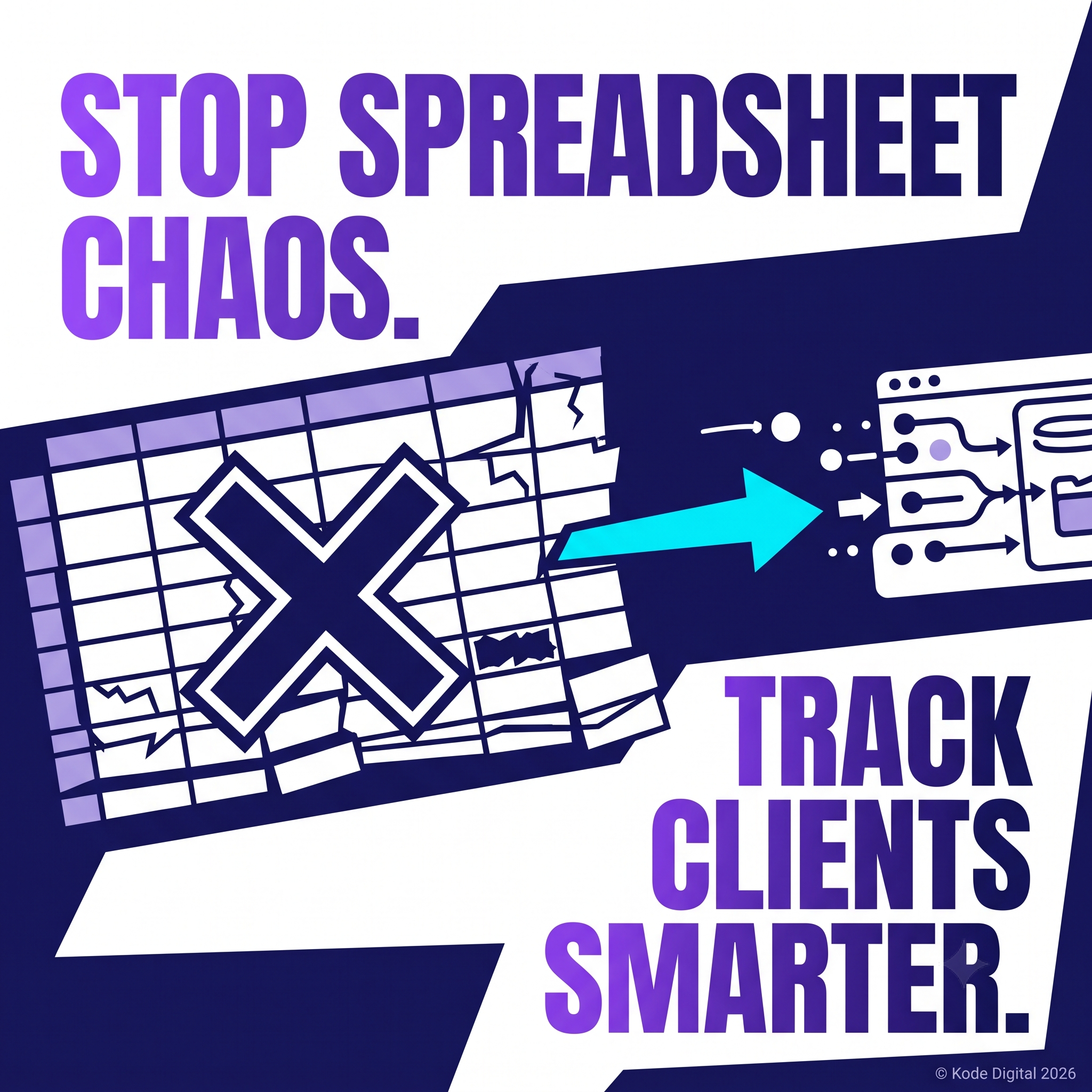
If your sales team in Petaling Jaya is still copy-pasting customer details into a shared Excel file, you are not alone — but you are leaving money on the table. Across the Klang Valley and beyond, thousands of Malaysian SMEs are managing their entire customer base through colour-coded rows, outdated formulas, and files that crash the moment two people open them at once. The good news is that moving away from spreadsheets is far simpler than most business owners assume.
The problem with spreadsheets is not that they are bad tools. They are excellent for crunching numbers. The problem is that they were never designed to manage relationships, and that distinction matters enormously when you are trying to grow.
Consider a typical scenario: a retail distributor operating out of Shah Alam has a team of five handling accounts across Selangor and Johor Bahru. Each salesperson maintains their own version of the customer list. One person updates a contact’s phone number. Another sends a follow-up email to the old number. A third closes a deal and forgets to update the sheet entirely. Within three months, the “master” file has three competing versions, and nobody is confident which one is accurate.
The real costs here are not just operational. Duplicate outreach annoys customers. Missed follow-ups lose deals. And when a key salesperson leaves, they often take institutional knowledge with them — knowledge that was never captured in the spreadsheet because there was no field for it. This is the silent churn that most Malaysian SMEs never measure.
The most common mistake is treating this as a technology problem when it is actually a process problem. Businesses sign up for a customer relationship management (CRM) platform, import their messy spreadsheet data directly, and then wonder why nothing has improved. The clutter simply migrates from one system to another.
A second mistake is over-engineering the solution from day one. Some owners, having spoken to a digital marketing agency or a technology consultant, become convinced they need an enterprise-level system with full automation, custom integrations, and multi-department pipelines before they have even cleaned their contact list. This leads to expensive implementations that the team never actually adopts.
The third mistake — and arguably the most damaging — is not assigning ownership. If nobody is accountable for keeping customer data accurate and up to date, the new system becomes an expensive version of the old spreadsheet within six months.
This process is designed for Malaysian SMEs moving away from manual tracking for the first time. It is practical, sequenced, and built to minimise disruption.
This is where things get genuinely exciting for Malaysian businesses willing to move fast. The latest generation of CRM platforms and standalone AI tools can now do things that were simply not possible with spreadsheets.
AI-powered systems can automatically log customer interactions from email threads, flag contacts that have gone quiet for too long, predict which leads are most likely to convert based on historical behaviour, and even suggest the best time to follow up based on past engagement patterns. Some platforms now integrate with social channels, including platforms like XHS (XHS meaning: Xiaohongshu, a popular Chinese social commerce app that has gained traction among Malaysian Chinese consumers) — allowing businesses to track customer touchpoints across multiple digital surfaces from a single dashboard.
For businesses working with an SEO agency or a broader digital marketing company to drive inbound leads, AI-enhanced CRMs also close a critical loop: they connect marketing attribution data directly to the sales pipeline, so you can see precisely which campaigns and channels are generating customers who actually convert and retain, not just click.
This level of intelligence is structurally impossible in a spreadsheet. You simply cannot build predictive logic or real-time data sync inside a static file.
You do not need to be a large organisation to benefit from proper customer tracking. But there are a few internal signals worth checking before you commit to a new system.
If two or more of those describe your current situation, the spreadsheet is already a bottleneck. The question is not whether to move, but how quickly you can do it without disrupting day-to-day operations.
Malaysian businesses that make this shift properly — with clean data, the right tool, and clear ownership — consistently report that their teams spend less time searching for information and more time actually serving customers. In a market as competitive as ours, where a Klang Valley consumer has dozens of alternatives a search away, that responsiveness is not a nice-to-have. It is how you protect and grow the customer relationships you have already worked hard to earn.
Disclaimer: Business technology requirements vary. Always evaluate any CRM or data management solution against your specific operational needs and applicable data protection obligations under Malaysian law before implementation.
353-3 Jalan C. Y. Choy,
10300 George Town,
Penang, Malaysia.
A-16-8 Tropicana Avenue,
No 12 Persiaran
Tropicana, PJU 3, 47410
Petaling Jaya, Selangor.






















 Singapore
 Australia