Our top-tier consultancy services provide strategic guidance to elevate your entire digital presence.
Learn More


 " />
" />
 " />
" />
 Max
|
July 20, 2026
|
Blog
Max
|
July 20, 2026
|
Blog
Contents
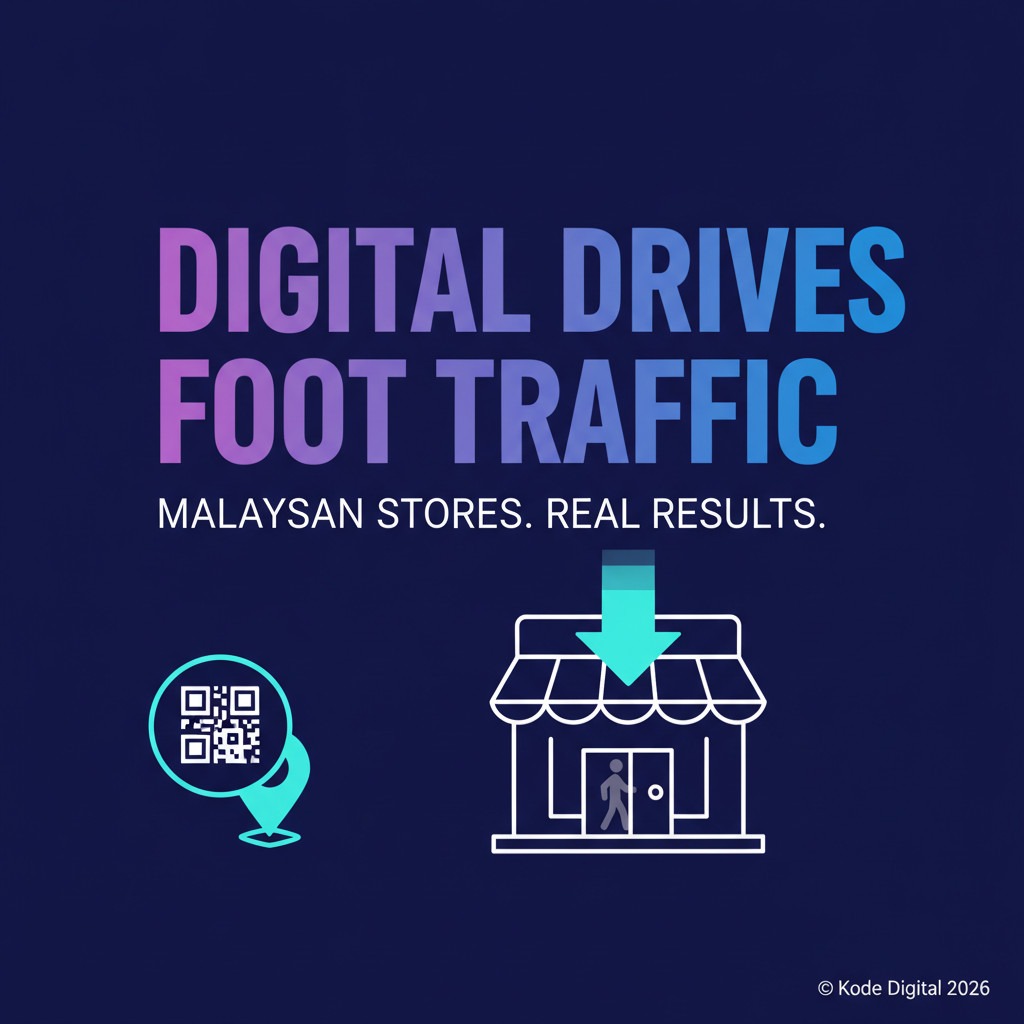
Walk through any shopping mall in Petaling Jaya or along a commercial row in Penang, and you will notice something telling: the stores doing the best business are not necessarily the ones with the fanciest shopfronts. They are the ones that showed up on someone’s phone before the customer ever left home.
That is the shift most retail owners in Malaysia understand in theory but have not yet acted on properly. Foot traffic does not start at your front door anymore. It starts the moment someone searches, scrolls, or asks a friend online. If your physical store is not woven into that digital journey, you are invisible — no matter how good your products are.
This is not about replacing the in-store experience. It is about solving the real problem: why do shoppers walk into a competitor two doors down when you have exactly what they need?
Malaysian shoppers increasingly use “near me” searches before deciding where to go. A well-optimised Google Business Profile is one of the highest-leverage tools a physical retailer can use to drive foot traffic — yet most store owners set it up once and forget it exists.
The problem is not the platform. The problem is that a neglected profile signals neglect to the algorithm and to the shopper. Outdated hours, no photos, zero responses to reviews — these are the digital equivalent of a dusty storefront.
Here is what active management actually looks like:
For retailers in Klang Valley or Johor Bahru operating in highly competitive categories, local SEO is genuinely the difference between a full car park and an empty one. Working with a capable digital marketing agency that understands local search behaviour can compress the learning curve considerably.
Here is where most retailers drift off course. They invest time in Instagram or TikTok, build a reasonable following, and then wonder why footfall has not moved. The issue is almost always a mismatch between content type and intent.
Content that drives foot traffic looks different from content that builds brand awareness. The former is explicit about location, timing, and reason to visit. The latter can be beautiful and engaging without ever prompting someone to physically move.
The key diagnostic question is always: does this post give someone a specific reason to visit, on a specific day, to a specific location? If the answer is vague, the content is doing brand work — which has its place, but will not solve a foot traffic problem on its own.
This is worth paying attention to, because it is already affecting Malaysian retail behaviour even if most store owners have not connected the dots yet.
AI-powered search — the kind embedded in platforms like Google’s Search Generative Experience and various chat-based tools — is increasingly answering “where should I go to buy X in KL?” with synthesised recommendations rather than a list of blue links. The businesses that appear in these answers are typically those with strong, consistent digital signals: well-maintained profiles, frequently updated content, genuine customer reviews, and accurate business information across multiple platforms.
AI marketing tools are also giving retailers new capability on the output side. Automated localised ad copy, predictive audience targeting, and dynamic content that adjusts based on proximity and time of day — these are no longer enterprise-only features. A forward-thinking digital marketing company serving Malaysian SMEs will already be incorporating these tools into campaign architecture.
For physical retailers, this matters because the decision journey is compressing. Shoppers are making up their minds faster, with less browsing. If you are not present and credible at the moment of AI-assisted decision-making, you are losing visits you never even knew were possible.
One of the more frustrating patterns in Malaysian retail is this: a business invests reasonably in digital marketing services, sees decent online engagement, but cannot trace any of it back to store visits. The root cause is almost always a measurement gap, not a performance gap.
Without a mechanism to connect digital activity to physical visits, you cannot optimise. You are flying blind. Some practical ways to close this loop:
None of this requires sophisticated software. It requires discipline and someone accountable for closing the loop between what you are spending digitally and what is walking through your door.
The retailers in Malaysia who are genuinely winning the foot traffic game are not doing something radically different. They are doing the fundamentals with unusual consistency. Their Google profile is never stale. Their social content always names a location and a reason to visit. They test paid local targeting monthly rather than sporadically. They have someone — internally or through a trusted digital marketing agency — who treats their digital presence as a living asset rather than a setup task.
The opportunity for physical retailers in Malaysia is real. Digital channels, used with intention, can reliably send people through your door. The businesses that figure this out in the next twelve months will be in a structurally stronger position than those still waiting for foot traffic to return on its own.
Disclaimer: Digital marketing strategies and platform features referenced in this article are general in nature. Businesses should seek professional advice tailored to their specific circumstances before implementing any marketing approach.
353-3 Jalan C. Y. Choy,
10300 George Town,
Penang, Malaysia.
A-16-8 Tropicana Avenue,
No 12 Persiaran
Tropicana, PJU 3, 47410
Petaling Jaya, Selangor.



















 Singapore
 Australia