Our top-tier consultancy services provide strategic guidance to elevate your entire digital presence.
Learn More


 " />
" />
 " />
" />
 Max
|
July 27, 2026
|
Blog
Max
|
July 27, 2026
|
Blog
Contents
Here is a scenario that plays out constantly across Klang Valley pet supply shops. A customer rings at 2pm to order a 10kg bag of dry food and three cans of wet food. The owner scribbles it down, keys it into WhatsApp for the driver, and marks it on a physical notepad. By Friday, three orders have been mixed up, one delivery went to the wrong address in Petaling Jaya, and the owner spent four hours that week just answering calls she never had time to return.
Phone ordering feels personal and controllable — until it quietly becomes the most expensive system in the business. The question for most Malaysian pet stores right now is not whether to move online. It is how to do it without breaking what already works, and what that shift actually costs you in time, money, and customer trust before it pays off.
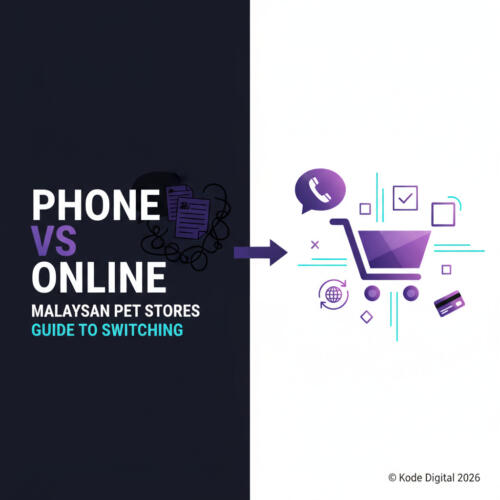
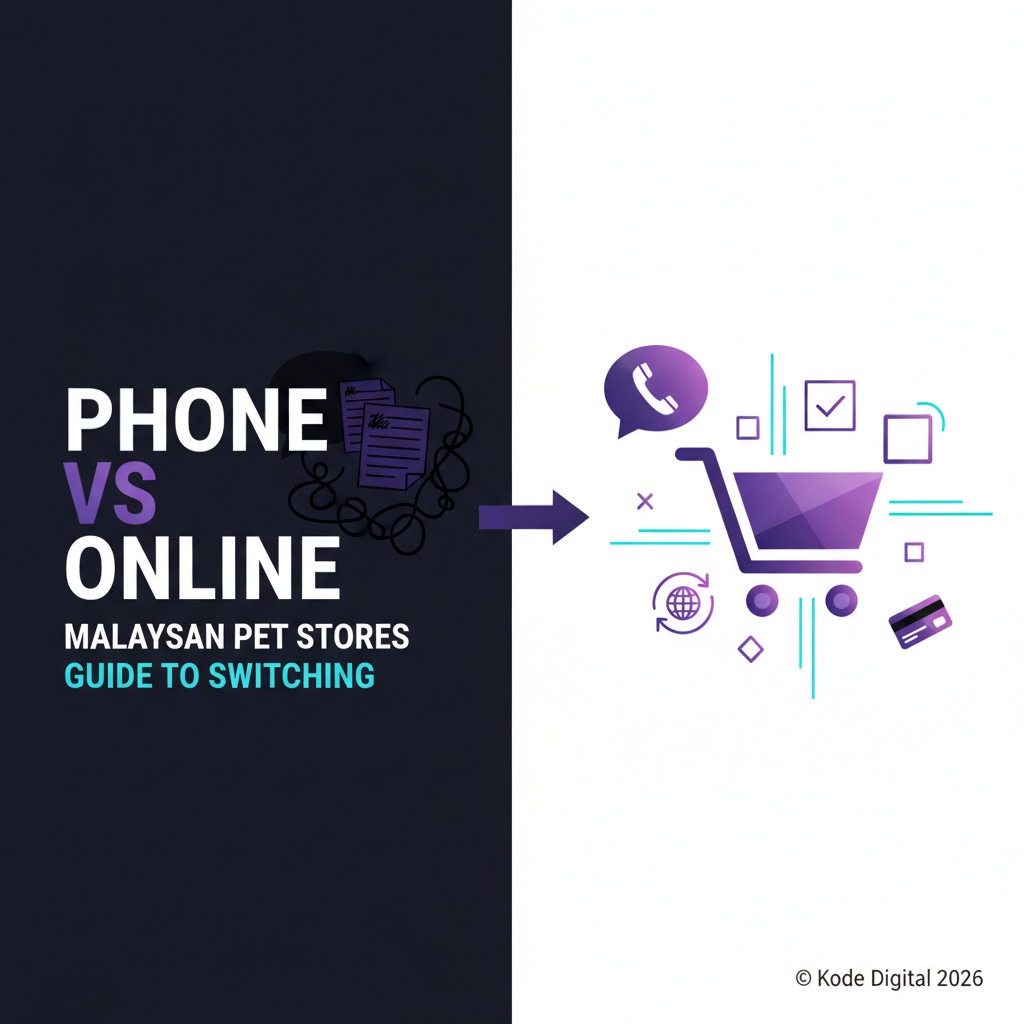
Moving from phone orders to online orders is fundamentally a comparison of two operating models — and the tradeoffs are rarely where owners expect them to be.
Phone ordering has one real advantage: low friction for the customer who already knows you. A repeat buyer in Johor Bahru who has been ordering the same brand of medicated shampoo for three years will call because it is faster than navigating a new website. That loyalty is real, and it is worth protecting.
But the hidden costs accumulate quietly:
None of this means phone orders should be eliminated overnight. The smarter read is to understand which orders benefit from staying on the phone — large custom orders, first-time buyers needing advice, or complex medical diet consultations — and which ones should be migrated online first.
Online order systems are not free to operate. This is where many pet store owners in Penang and KL get a rude shock after the initial setup excitement fades.
A basic e-commerce setup — whether through a local platform or a custom build — carries setup fees, payment gateway integration costs, and potentially SST registration implications if you cross revenue thresholds. A proper product catalogue for a mid-sized pet store with 200 to 400 SKUs takes longer to build than most owners anticipate. Budget at minimum two to three weeks of someone’s time just on product data entry and photography.
Malaysian online shoppers have high expectations shaped by years of using Shopee and Lazada. If your checkout is clunky, your payment options are limited (most customers expect FPX, Touch ‘n Go eWallet, and at least one BNPL option), or your mobile experience is poor, abandonment rates will be punishing. This is not a minor detail to fix later — it is the primary reason online stores in this market underperform despite having good products.
Phone orders often run on informal delivery arrangements — a driver, a fixed schedule, relationships. Online orders create demand for tracked, on-demand fulfillment. Connecting your store to a courier API or third-party logistics provider adds both cost and technical complexity. The upside is that customers get real-time tracking and you stop fielding “where is my order?” calls entirely.
Here is the part most pet store owners underestimate when they launch an online store: the store alone does not bring customers. A website with no traffic is a phone that never rings.
Organic search is where sustainable online order volume is built. When someone in Petaling Jaya searches “buy cat food online delivery KL” or “pet grooming supplies Penang,” the stores appearing at the top of those results are not there by accident. They have invested in SEO — optimising product pages, building content that answers real buyer questions, and earning the kind of domain credibility that takes months to accumulate.
A qualified SEO agency that understands Malaysian search behaviour will approach this differently from a generic template. Local search intent in Malaysia mixes English, Bahasa Malaysia, and occasionally Mandarin. A store in Penang targeting English-language searches while its customers search in Malay is leaving significant traffic on the table.
For pet stores specifically, the highest-converting search traffic tends to come from people already in purchase mode — searching for a specific brand, a specific condition (grain-free, hypoallergenic, senior formula), or a specific service (same-day delivery). Capturing that traffic requires structured product pages, clean site architecture, and consistent updates — the kind of ongoing work a digital marketing company builds as a systematic programme, not a one-time fix.
This is also where digital marketing services start to show measurable return. Email capture from first-time online buyers, retargeting campaigns for cart abandoners, and loyalty programme mechanics all compound over time in ways that phone order systems structurally cannot replicate.
The businesses that transition most cleanly do not flip a switch. They run both systems in parallel, migrating order types selectively.
Working with an experienced agency for digital marketing that understands the Malaysian SME landscape — including the specific buying behaviour of pet owners in urban centres like Johor Bahru and Klang Valley — shortens the learning curve significantly. The mistakes are predictable. The solutions are documented. The question is whether you are building that knowledge internally or accessing it externally.
Pet stores that made this transition two or three years ago are now sitting on customer databases, automated reorder reminders, and search rankings that their phone-only competitors cannot replicate quickly. The gap is widening, not narrowing. Getting the architecture right at the start — rather than rebuilding a broken system six months in — is the only version of this story that makes operational sense.
Disclaimer: Business regulations, SST thresholds, and platform requirements change periodically — verify current requirements with the relevant Malaysian authorities before making commercial decisions.
353-3 Jalan C. Y. Choy,
10300 George Town,
Penang, Malaysia.
A-16-8 Tropicana Avenue,
No 12 Persiaran
Tropicana, PJU 3, 47410
Petaling Jaya, Selangor.




















 Singapore
 Australia