Our top-tier consultancy services provide strategic guidance to elevate your entire digital presence.
Learn More


 " />
" />
 " />
" />
 Max
|
July 13, 2026
|
Blog
Max
|
July 13, 2026
|
Blog
Contents
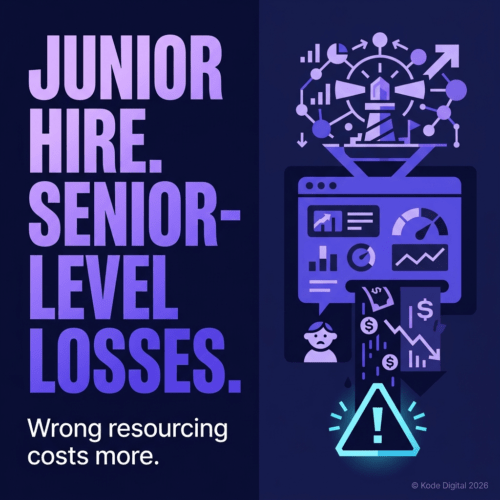
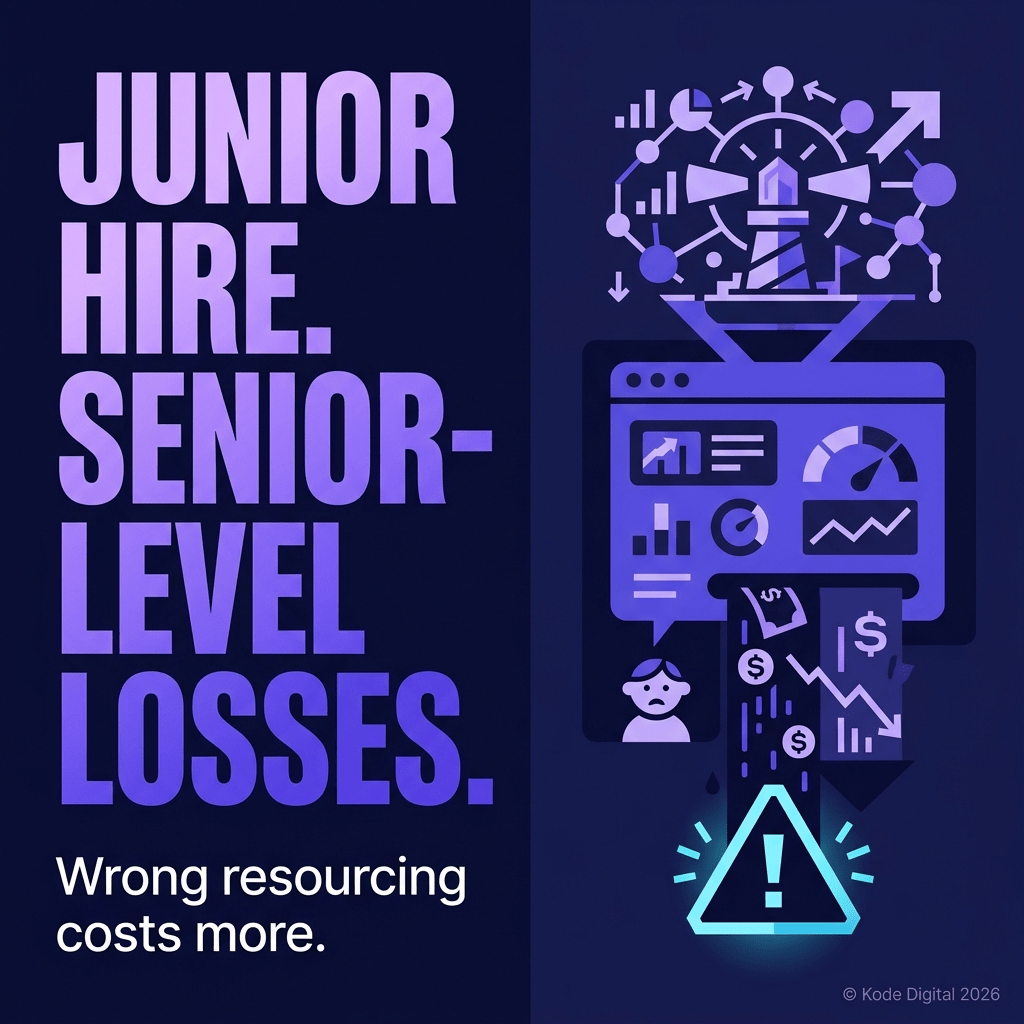
Here is a scenario that plays out more often than most Malaysian business owners care to admit. A catering company in Petaling Jaya is growing steadily — corporate lunch orders, event packages, a few weddings a month. The owner decides it is time to get serious about digital marketing. Rather than engaging a proper digital marketing agency, they bring in a fresh graduate at roughly RM2,500 a month and hand over the entire marketing function: social media, Google Ads, content strategy, the works.
Six months later, the ad spend has quietly haemorrhaged RM18,000. The Instagram page looks nice. Leads? Almost none. The owner concludes that digital marketing simply does not work for their industry. That conclusion is wrong. The resourcing decision was the problem — not the channel.
This is not a story about blaming junior talent. It is about understanding what senior marketing work actually demands, and why mismatching skill level to task complexity is one of the most expensive operational mistakes a growing Malaysian business can make.
Senior marketing work is not defined by the tools involved. Anyone can be taught to schedule posts or upload a campaign into an ads dashboard. What separates junior execution from senior strategic work is the ability to make consequential decisions without supervision — and to anticipate downstream effects before they become costly problems.
Consider what running a full digital marketing function for a catering business in the Klang Valley actually involves:
These are not tasks that can be learned adequately within three months on the job. They require pattern recognition built across dozens of previous campaigns, often across different industries and budgets. A junior hire working alone does not have that reference library yet. That is not their fault — it is simply a function of experience.
When owners compare the cost of a junior hire against engaging a professional digital marketing company, they usually look at monthly salary versus monthly retainer. That comparison misses most of the actual cost.
An inexperienced marketer managing paid campaigns will almost always spend more to achieve the same result — if they achieve it at all. Poor keyword selection, weak bidding strategy, and untested ad creative all bleed budget. On a RM3,000 monthly ad spend, even a 30% efficiency gap represents RM900 wasted every month — more than RM10,000 a year, on top of the salary cost.
While a junior hire is building competency, competitors who invested in proper expertise are acquiring customers. In competitive segments like corporate catering across KL and Johor Bahru, that window matters. Market share conceded during a slow learning curve is rarely recovered easily.
Junior staff working in a senior capacity need guidance — frequently. If the owner is providing that guidance, their time has a cost attached to it. If no guidance is provided, the work drifts. Either way, the business pays.
Poor SEO work, for instance, can require months of remediation. A website structured incorrectly for search from the outset — something an experienced digital marketing services team would flag immediately — can take significant time and spend to fix. Every piece of content published without proper keyword architecture is content that actively underperforms and must eventually be revised or replaced.
Some businesses now assume that AI tools effectively close the experience gap — that a junior hire equipped with the right software can perform at a senior level. This thinking is partially right and substantially wrong.
AI has genuinely democratised certain execution tasks. Drafting initial content variations, generating keyword clusters, producing image assets — these are faster now. A junior hire using AI tools can produce more output in less time than was possible five years ago.
But output volume is not the same as strategic quality. AI does not know that the catering company’s best-margin product is their premium event package, not their office lunch service. It does not know that a campaign targeting Penang corporate clients should be framed differently from one targeting Klang Valley prospects. It cannot interpret a sudden drop in conversion rate and trace it back to a landing page load time issue triggered by a recent website update.
Judgement, prioritisation, and strategic coherence still require a human with genuine experience. AI amplifies capability — it does not replace the foundation of expertise that senior marketing work demands. A skilled professional at a reputable agency for digital marketing uses AI as a multiplier on top of deep domain knowledge, not as a substitute for it.
The goal is not to avoid hiring junior staff. Junior talent has real value in execution-heavy roles where the work is well-defined, supervised, and not directly responsible for strategic outcomes. The goal is to stop assigning senior-level accountability to junior-level experience and expecting a senior-level result.
For a growing catering business — or any Malaysian SME working within a defined monthly marketing budget — a more effective model typically looks like this:
Businesses that resist this structure often do so because they are optimising for the lowest visible monthly cost. What they are actually doing is accepting a higher total cost — paid in wasted ad spend, lost leads, and slower growth — distributed across time in a way that is harder to see on a single invoice.
The Malaysian market is competitive enough that the businesses pulling ahead are the ones making smarter resourcing decisions, not just louder marketing ones. Getting the capability level right from the start is not a premium — it is the baseline for work that actually delivers.
Disclaimer: Figures and scenarios referenced in this article are illustrative and intended for general informational purposes only. Individual business results will vary based on specific circumstances, industry, and market conditions.
353-3 Jalan C. Y. Choy,
10300 George Town,
Penang, Malaysia.
A-16-8 Tropicana Avenue,
No 12 Persiaran
Tropicana, PJU 3, 47410
Petaling Jaya, Selangor.



















 Singapore
 Australia