Our top-tier consultancy services provide strategic guidance to elevate your entire digital presence.
Learn More


 " />
" />
 " />
" />
 husna
|
October 1, 2026
|
Blog
husna
|
October 1, 2026
|
Blog
Contents
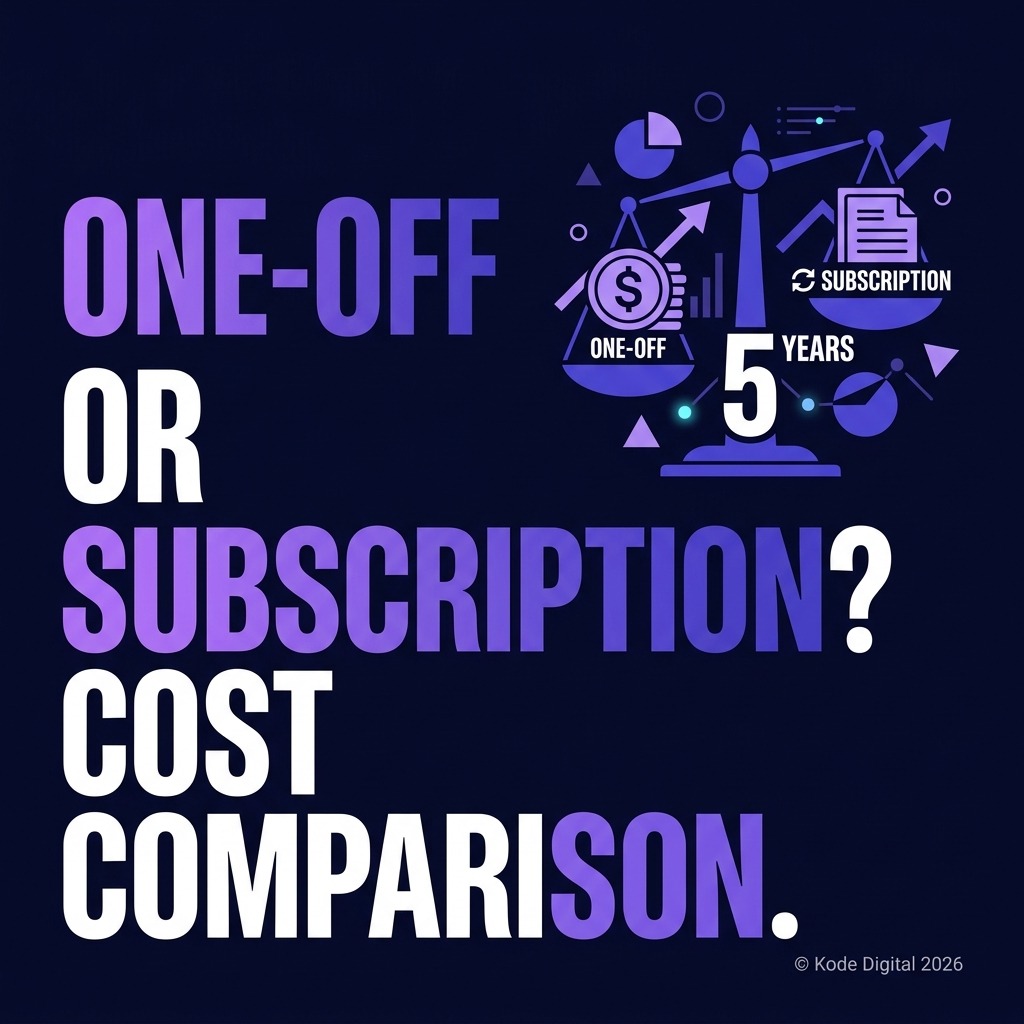
Software pricing looks simple until you have to compare it. One vendor quotes a small monthly fee per user. Another quotes a single larger figure and says “no monthly fees”. Which one costs less? The honest answer is “it depends”, but you can make it depend on numbers instead of instinct.
This guide shows how to compare one-off and subscription business software over five years, with a formula, a worked example, a hidden-cost checklist and a decision guide. It is written for finance, HR and IT leads in Malaysian organisations weighing systems such as Kunos, our AI-powered business operating system.
One-off software is often cheaper over five years for organisations with many users and stable needs, because the cost does not scale with headcount. Subscriptions are usually cheaper for small teams, short projects or fast-changing requirements, because they need little upfront cash and shift upgrades to the vendor. The crossover point depends on your headcount, price per user and the ongoing costs of the one-off option.
Use total cost of ownership: the purchase price plus every cost of running the system across its life. IBM describes TCO as covering direct costs, such as the purchase price, and indirect costs, such as time spent adjusting to new systems. Here is a practical version for each model.
| Model | 5-year cost formula |
|---|---|
| Subscription | (Users × price per user per month × 60 months) + add-on modules + expected price rises + implementation and training + internal admin time |
| One-off | Licence or system fee + implementation and training + annual support, hosting and maintenance × 5 + upgrades + internal IT time |
For a fair comparison, use the same scope on both sides: same modules, same users, same integrations, same support level. Where costs land in different years, BDC notes it is worth adjusting future costs to today’s value, because the timing of money matters. Ask your finance team whether to include that adjustment.
Illustrative assumptions only, not real prices: the subscription costs RM10 per user per month. The one-off system costs RM60,000 for licence and setup, plus RM6,000 a year for support and hosting, and its price does not change with the number of users. Both cover the same modules.
| Users | Subscription over 5 years | One-off over 5 years | Cheaper option |
|---|---|---|---|
| 50 | RM30,000 | RM90,000 | Subscription |
| 100 | RM60,000 | RM90,000 | Subscription |
| 150 | RM90,000 | RM90,000 | Break-even |
| 300 | RM180,000 | RM90,000 | One-off |
The one-off total is RM60,000 plus five years of RM6,000 support (RM30,000), which comes to RM90,000. The break-even formula is: users = one-off 5-year total ÷ (price per user per month × 60). Here that is RM90,000 ÷ (RM10 × 60) = 150 users. Below 150 users the subscription is cheaper. Above it, the one-off option is.
Now add a price rise. If the subscription increases by 5% each year, the 150-user total grows from RM90,000 to about RM99,461, so the one-off option is already ahead at that headcount. Real contracts vary, so check each vendor’s renewal terms. Also test the other direction: if a one-off price scales with users or modules, the break-even moves.
| Choose one-off when… | Choose a subscription when… |
|---|---|
| Headcount is large or growing, so per-user fees multiply. | Your team is small and growth is uncertain. |
| Your processes are stable and you want predictable long-term cost. | Your needs are changing fast and you want flexibility to switch. |
| You need data control, such as on-premise or regional hosting. | You want the vendor to handle hosting, updates and scaling. |
| You can plan a larger upfront investment and have budget for support. | You need low upfront cost or prefer operating expenditure. |
| You plan to use the system for 5 years or more. | You may replace the system within 2 to 3 years. |
Ask your finance team and tax adviser how each model is treated in your accounts and for tax. That treatment can change the real cost, so this guide does not assume it either way.
Kunos is offered as a one-off system investment tailored to your organisation, with no monthly subscription fees. There are three tiers. Core covers dashboard and reporting plus staff and leave management, with AI Document OCR and Finance & Inventory as optional add-ons. Operations adds AI Document OCR and custom workflows. Enterprise adds Finance & Inventory, custom workflows and a dedicated manager. Modular AI SmartPacks can be added to any tier.
Kunos pricing is set through a personalised demo rather than a public price list, so the numbers above are for method only. When you request a quote, use the formula in this guide and ask about annual support, hosting and upgrade terms so you can compare like for like. A one-off model is not automatically cheaper for every organisation, and we would rather you model it than take our word for it. Most organisations are configured and running within 2 to 6 weeks. Kunos also fits organisations that need on-premise or regional cloud hosting, including government-linked companies.
For the operational side, see how Kunos handles leave and MC digitisation, and explore our AI automation services if you want to automate more of your admin work.
Not always. One-off software tends to be cheaper over five years for organisations with many users and stable needs, because cost does not grow with headcount. Subscriptions tend to be cheaper for small teams and short horizons. Work out your break-even point using your own numbers.
Divide the one-off 5-year total by the subscription cost per user over 5 years. In formula form: users = one-off 5-year total ÷ (price per user per month × 60). Below that headcount the subscription is cheaper. Above it, the one-off option is cheaper.
Total cost of ownership includes the purchase or subscription price, implementation, training, integrations, annual support and hosting, upgrades, security and compliance work, and internal staff time. Count both direct and indirect costs across the whole period.
No. One-off pricing usually removes monthly licence fees, but you may still pay for support, hosting, maintenance and upgrades. Ask for these in writing so you can compare properly.
Kunos is offered as a one-off system investment with no monthly subscription fees, tailored to the organisation. Pricing is confirmed through a personalised demo. Ask about annual support, hosting and upgrade terms when you request a quote.
Five years is a common horizon for core business systems, because it is long enough to capture renewals, support and upgrades. If you expect to replace the system sooner, use a shorter period.
Tell us your headcount, branches and modules, and our Customer Success team will walk through Kunos options and how to compare them fairly. Schedule a demo on WhatsApp, or read more about Kunos. We support organisations across Penang, the Klang Valley and the rest of Malaysia from George Town and Petaling Jaya.
About the Author: Husna writes about business systems, compliance and digital transformation for Kode Digital.
Kode Digital Sdn Bhd is a Malaysian digital agency with offices in George Town, Penang and Petaling Jaya, Selangor. It builds Kunos, an AI-powered business operating system for Malaysian organisations.
353-3 Jalan C. Y. Choy,
10300 George Town,
Penang, Malaysia.
A-16-8 Tropicana Avenue,
No 12 Persiaran
Tropicana, PJU 3, 47410
Petaling Jaya, Selangor.



















 Singapore
 Australia